“Transitions” is the title of the latest exhibition by a young-generation artist, Maciej Strumiło. It refers to his previous artistic event bearing the same title, though presented in its Polish version: “Przejścia” (“Passages”). Both names have a symbolic and multifaceted meaning, and both relate to a cycle of works whose main element consists of textile graphics which, although they reference both the art déco movement of the interwar period and the minimalist art of the 1960s, reach deep into the tradition of human thought.
Each of the presented works is a kind of passage, a gate leading to “the other side.” The other side of what? Life, faith, a mirror – including the inner mirror. Everyone has their own “other side.” A “passage” allows one to move from somewhere to somewhere else, to cross to the other side or become stuck in between. In the first case, the passage is a road toward something better, a higher level of consciousness or self-knowledge, and may serve the function of “catharsis.”
In the second case, we encounter a boundary situation – a “suspension in the void,” attributed to the insane or the excluded, those pushed outside societal norms. For them, this state is a challenge, a signal to fight in order to emerge on the other side of the passage. In the past, the “suspended in the void” were those subjected to mediation: people who died suddenly – suicides, children who died shortly after birth and were not baptized, as well as various outcasts. All of them were condemned to “social nonexistence.” Communities that failed to perform the proper rituals condemned them to a liminal state. Cultures dominated by mythic worldviews created a complex system of rules governing attitudes toward people in this intermediate condition.
The fundamental opposition of rites of passage is the opposition of life and death. A person who is “in passage” between one state and another is, in fact, neither here nor there. This person may be a madman or, more broadly: an outcast. Sometimes it is an artist. Sometimes – any one of us. Every person encounters symbolic gates in their life, after crossing which they feel reborn, saved, and/or purified. It is no coincidence that we say someone has “been through a lot.” These are the “passages.”
And a “transit”? It is more like just “passing through.” Quickly moving something from point A to point B. Or traveling that route oneself without stopping, since the journey’s end is what matters. This is the journey described by Maciej Strumiło. The journey of life. His own Life Journey. That is why the main object is a platform with stairs leading toward Heaven. After all, each of us is only “passing through,” here only “for a moment,” on the way to… Where? We do not know.
Strumiło’s stairs lead upward, higher, to elevated states of consciousness and liberation. Liberation of both spirit and body. Or perhaps: the Liberation of the Spirit through the Emancipation of the Body. From above, a textile with the Artist’s face, the “Ciań,” flows down the stairs, reminiscent of the most famous Turin cloth. However, while the Shroud of Turin is a symbol of death, Strumiło’s fabric is its opposite: a symbol of life, simultaneously depicting the Life Path and the Artistic Creative Process, which ultimately transforms into an Opus Vitae.
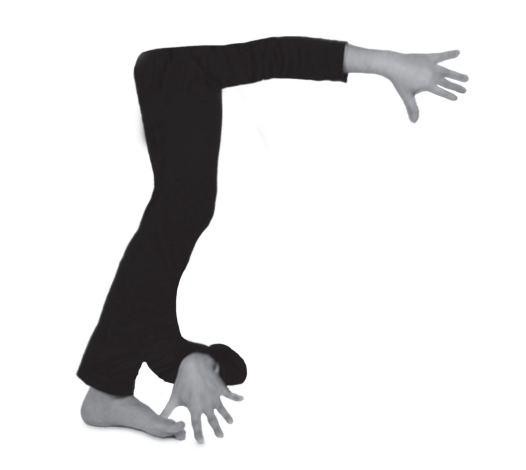
That it is Life, not Death, imprinted on the “Ciań,” is evidenced by dozens of dance movements surrounding the centrally placed image of the Artist. This is also a kind of visual dialogue between the Artist and the world, as he appears not only in the central image on the textile but also in every dynamic sign surrounding it. His body, with all its movements and gestures, becomes a communication tool connecting him with the surrounding reality. In this way, the Creator communicates both with himself – conducting a kind of “inner monologue” – and with every participant in his art. Thus, he invites viewers into an artistic dialogue. Each viewer becomes an interlocutor and co-creator of the work, participating in its creation. This is a form of concretization in the Ingardenian sense.
The “freeze-frames” of the Artist’s life are artifacts captured in time and form. In every frame, Strumiło is enclosed as if within the borders of a painting, which both highlight his figure and imprison it. The solo choreographic arrangement is more than just a movement-based composition. It portrays the human and the artist’s situation. It is solitude but also an attempt at dialogue. It is remaining closed off but also attempting to open. Will it succeed? The Creator is still searching for that answer, as shown by another of his images – this time enclosed in an oval like a cocoon separating him from the world. Yet the connection has not been completely severed, suggested by the Hamlet-like gesture: an open hand with the palm turned upward. This time without a skull, but with the same question. Whether the answer has been found – we can only assume yes, since the Artist stands on the other side of the symbolically marked gates.
Over all these actions, the All-Seeing Eye watches – the eye of providence. It may symbolize divine protection, but also references the Eye of Horus, an ancient Egyptian symbol of rebirth and healing. If we accept that the platform with stairs leading toward Heaven is a kind of pyramid, then the providential eye above it may serve as a warning not to succumb to easy temptation. Not without reason is this symbol found on the reverse of the American one-dollar bill.
There are more symbols hidden in Strumiło’s works. We may also find a chalice or cup, associated with a vast range of symbolism. The chalice is an attribute of kings and high priests; it may signify destiny, as suggested in Psalm 15: “The Lord is my chosen portion and my cup; you hold my lot.” But just as it may be a reward, it may also bear punishment: “For in the hand of the Lord there is a cup of foaming wine, well mixed, and he pours out from it, and all the wicked of the earth shall drain it down to the dregs” (Psalm 74). The cup symbolizes joy, wisdom, justice, foresight, blessing, delight, generosity, openness, and friendship. Yet it also symbolizes fate and destiny; and simultaneously salvation and immortality.
Similarly rich in meaning are the gates that form the leitmotif of Strumiło’s artistic work. A gate or door symbolizes passage from one state to another. It may represent the transition between life and death, birth, rebirth, victory, or glory. Heavenly gates or solar gates represent passage into the divine realm. In many religions, behind the closed gate lies the land of the dead, while closed doors symbolize mystery. Consequently, opening them signifies revealing the unknown.
Triumphal gates were built for victorious leaders; standing at their threshold was a sign of glory and achieved victory (including victory over oneself). In ornate city gates, guests were once greeted. A gate symbolizes the most beautiful greeting: the arrival of a new human being. Thus it symbolizes birth, a transition between two worlds: light and darkness, life and death, the earthly and the sacred, poverty and wealth. Gates represent both beginnings and endings. In Christianity, they symbolize the human soul and salvation. A gate may be a threshold one must not cross, yet it can also symbolize knowledge and understanding, discovery and revelation, triumph and victory. It is almost always a symbol of change and of embarking on a new life path. The Artist, both Creator and guide, therefore asks each of us:
QUO VADIS?
Let us remember: each of us is here only “in transit.” Just passing through…